News of M&A or activist activity has a tendency to promote market speculation, resulting in increased volatility. Recent events around Unilever LSE:ULVR and Nelson Peltz, founder of hedge fund Trian Partners, are no exception.
Advances in machine learning and artificial intelligence (AI) make it possible to recognise and classify the behaviour of underlying market dynamics and the allocations (and reallocations) of portfolio capital and risk. Since 2018 the London Stock Exchange has made some of these AI data and analytics available to issuers directly though their Issuer Services Platform. The data is supplied by Irithmics, a UK-based AI research and technology firm specialising in the market dynamics of the decisions of investors.
What AI can tell us about speculative activity in a stock
Below is a screenshot of the alerts this AI raised in response to changes it recognised in the speculative behaviour of institutional investors towards Unilever. These are intriguing because the AI recognised changes in the way the speculative capital of the ‘smart money’ was being allocated and reallocated (with respect to Unilever) before financial news media reported the events.
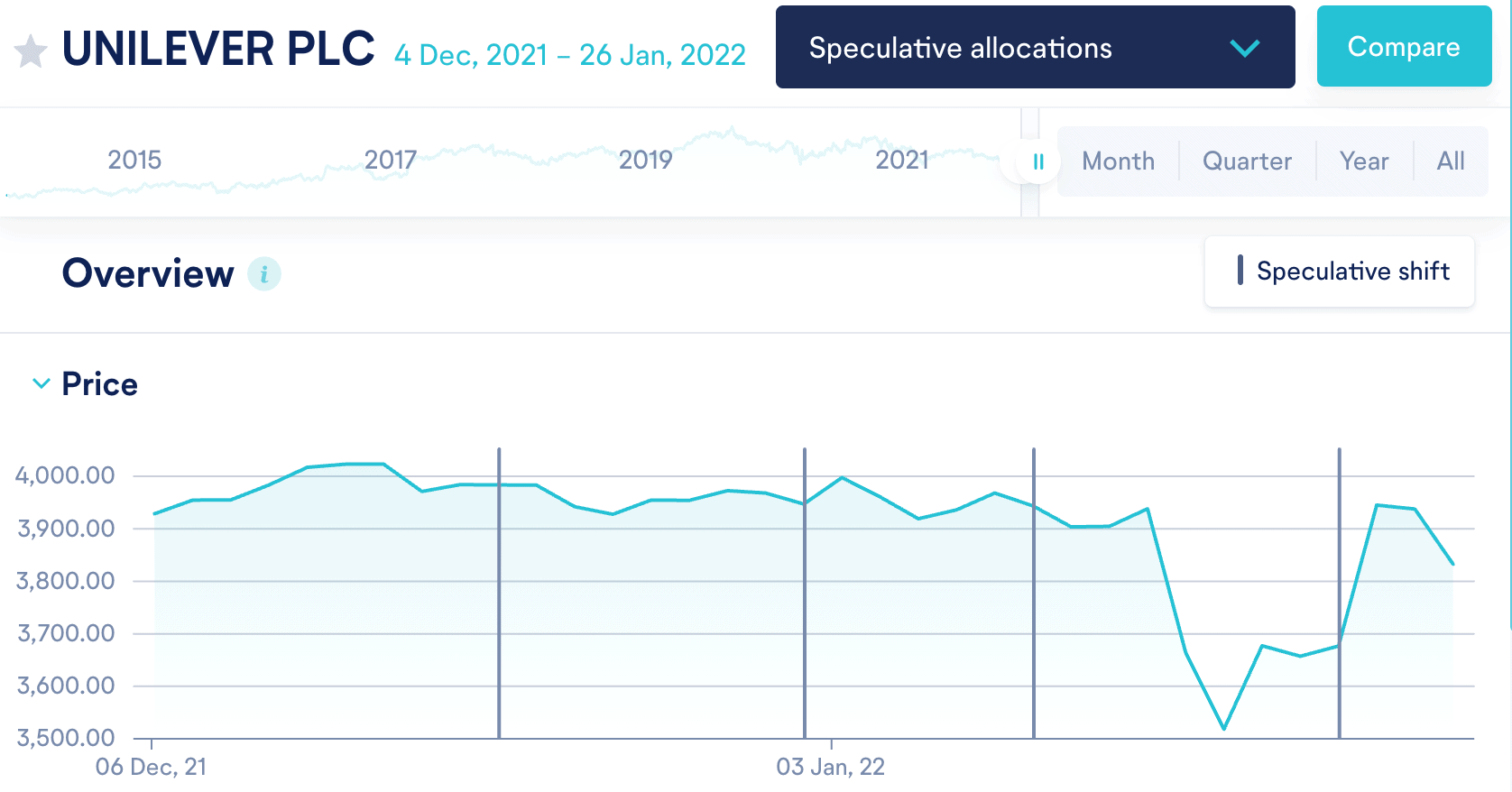
These alerts (represented by the vertical lines on Unilever’s stock price chart) are the result of the AI recognising changes in market dynamics and behaviour (rather than specific or maleficent behaviour), and occurred on 17 December 2021, 31 December 2021, 11 January 2022 and 21 January 2022.
As mentioned above, what’s intriguing is that many of these alerts occurred in the days before financial news outlets and journalists reported their stories, most significantly, news about the stake by Nelson Peltz’s Trian Fund Management. The hedge fund has a long and successful track record of unlocking value for investors. Its strategy often focuses on splits and spin outs, and it surprised the market with its sudden and aggressive move into Unilever when the news finally broke on 22/23 January.
Unilever management created a furore originally with its £50bn bid for GlaxoSmithKline’s LSE:GSK healthcare division. About a week earlier GSK had said it had rejected three bids from Unilever. GSK argued that the Unilever offer fundamentally undervalued GSK’s consumer business and its future prospects. GSK still plans to have this part of its empire off and list it separately.
AI-based analysis of activity in Unilever shares
The media broke news of Peltz’s holding in Unilever on Sunday 23 January. This analysis suggests some investors in the stock (enough for the AI to detect) had changed their behaviour by COB on the preceding Friday (21 January). It’s not difficult to do a chronology of other events (e.g. Unilever’s bid for GSK, news of the rejection etc).
While this does raise legitimate questions around regulation, compliance and market surveillance it also provides some participants with the possibility to profit. As Keynes said, “successful investing is anticipating the anticipations of others” and it looks as if institutional investors are using AI technology to anticipate, recognise and classify the behaviour of funds in the market, and profit from their vicarious analysis.
You can learn more about how artificial intelligence is being used to provide insights into fund manager activity in stock markets by watching this video.